Wed. Apr 22nd, 2026

Marathon Money Members Only: The Opendoor Thesis

ByCoinz

April 21, 2026

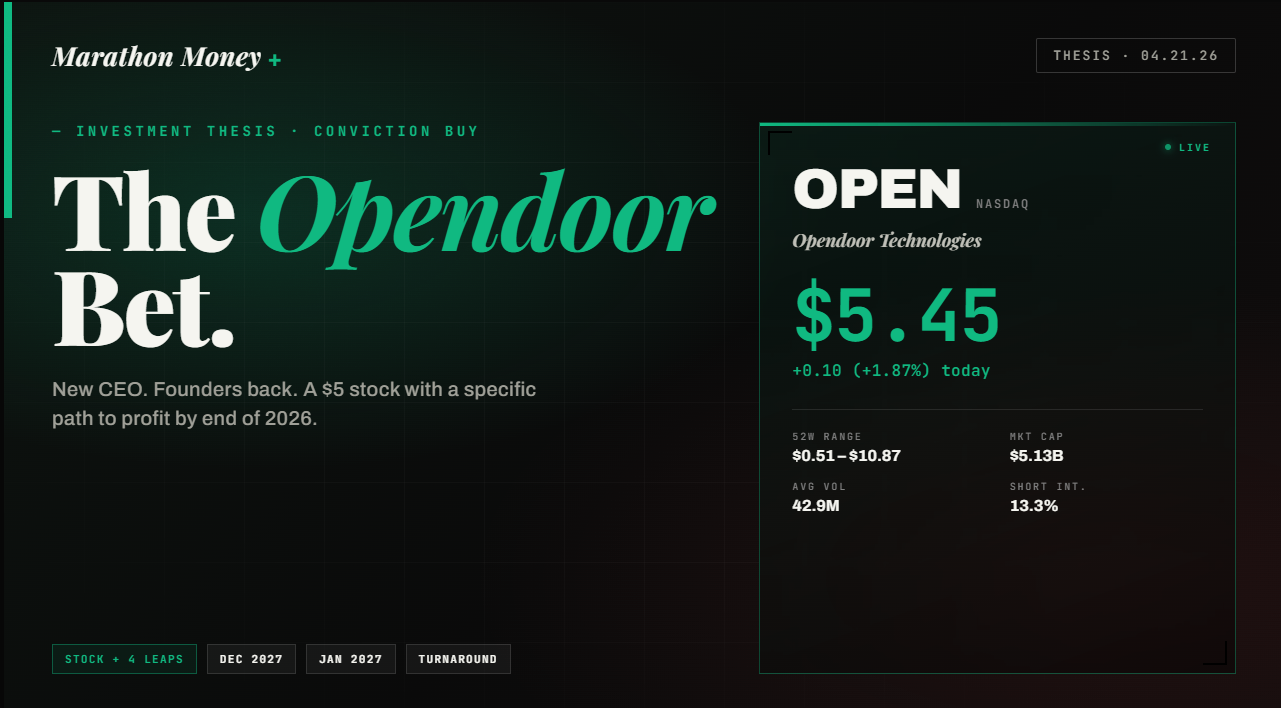
Ticker: OPEN (NASDAQ) | Entry Price: $5.45 | Date: April 21, 2026 Author: Kenny Colin, Marathon Money

Disclaimer

This is an investment thesis for educational purposes based on public information. It is not personalized financial advice. Options carry unique risks including total loss of premium paid, and long-dated contracts on a volatile small-cap stock are not suitable for every member. Marathon Money has no paid relationship with Opendoor or its management. Kenny has independently reached out to CEO Kaz Nejatian requesting an on-camera interview; that request is unrelated to the analysis below. Size every position to what you can afford to lose.


The One-Paragraph Thesis

Opendoor at $5.45 is an asymmetric bet on one of the most aggressive public-company turnarounds I’ve seen in years. A new CEO with a credible operator track record took over in September 2025, has executed visibly every single week since, tethered his own $2.7 billion potential payout to the stock price hitting $33, and is running the playbook publicly at accountable.opendoor.com. The company is targeting adjusted net income profitability by year-end 2026 on a 12-month forward basis. Macro is tilting their way. The short interest, float, and retail attention profile make this a name that moves violently on execution proof points. I’m building a core long position in the common shares and layering in a three-strike options ladder to get paid if the thesis plays out between now and December 2027.


What Kaz Nejatian Has Actually Done (Eight-Month Timeline)

August 2025 — The Uprising

Activist investor Eric Jackson of EMJ Capital led a public pressure campaign against former CEO Carrie Wheeler. Retail investors piled in. The stock ran 10x off its late-June lows. Wheeler stepped down. The company was simultaneously staring at a Nasdaq delisting on the minimum bid price rule.

September 2025 — The Refounding

Nejatian — the Chief Operating Officer of Shopify — took the CEO role on September 15. Co-founders Keith Rabois (now Chairman) and Eric Wu rejoined the board. Christy Schwartz took interim CFO (made permanent shortly after). Nejatian walked away from his Shopify package and accepted a compensation structure where almost all of his upside is tied to stock performance — up to 81.8 million shares vesting over five years, full vest only if OPEN hits $33. That’s a $2.7 billion personal stake that is worth nothing if the stock goes nowhere. That is alignment.

October–November 2025 — Break with the Past

Nejatian cut 300 employees in his first weeks (from roughly 1,400 down to 1,100). He ended the company’s reliance on outside management consultants. He called the old Opendoor “broken” and said it had “lost faith in the power of software.” He identified that twelve employees had been tasked purely with copying data from PDFs into spreadsheets. He brought back return-to-office.

November 6, 2025 — Opendoor 2.0 Announced

At Q3 earnings, he unveiled the four-step plan:

  1. Reach breakeven adjusted net income by end of 2026 on a forward 12-month basis
  2. Drive positive unit economics through tighter spreads and faster resale velocity
  3. Build operational leverage by being “ruthless on expenses”
  4. Launch AI-powered products across the homebuying lifecycle

He launched accountable.opendoor.com, where weekly acquisition counts and product shipments are tracked publicly. This is the opposite of corporate PR discipline. It’s a commitment device.

December 2025 — Leadership Deepens

Lucas Matheson (former CEO of Coinbase Canada) named President. Nejatian kept shipping AI-powered features and product changes at what he calls “Shopify cadence.”

February 19, 2026 — Q4 2025 Earnings: The First Proof Point

  • Revenue: $736M, beat consensus by 23.7%
  • EPS: -$0.07 vs -$0.10 expected (30% beat)
  • Homes acquired in Q4: 1,706 — a 46% jump from Q3’s 1,169
  • Acquisition velocity up 300% since Nejatian took over in September
  • Recent weekly pace hit 537 homes bought in a single week
  • Fixed operating expenses: $35M, down from $37M in Q3 and $43M year-over-year
  • Nejatian’s exact quote: “We’re on track. We’re driving Opendoor to be adjusted net income positive by the end of 2026.”

March 31, 2026 — The Doma Acquisition

Opendoor acquired the closing and escrow operations of Doma — a title-automation fintech — and partnered with Fannie Mae on the Title Acceptance Program. This is the strategic pivot that matters. Opendoor is no longer “just” an iBuyer. It’s positioning itself as closing infrastructure for American residential real estate. Matheson framed it directly: “Our first step towards Opendoor becoming the closing infrastructure for American real estate.” Terms were undisclosed.

April 2026 — Setting Up the Next Print

Q1 2026 earnings are scheduled for April 30. Nejatian has already guided to an adjusted EBITDA loss in the low-to-mid $30 million range — a significant improvement from the Q4 loss of approximately $50 million. Q1 revenue will be softer because the company deliberately ran Q4 inventory low.


Why I Believe This Works

1. The CEO is the asset

Nejatian is a product operator with a Shopify track record, not a real estate tourist. His compensation structure proves he believes in the setup. He’s been running a founder-mode playbook publicly — podcast interviews on Sequoia’s “Crucible Moments,” the Pomp Podcast, TBPN, a16z. He live-streams earnings in a black t-shirt that says “Faster.” He doesn’t work with PR firms. This is a different kind of operator.

2. The accountability is real

Accountable.opendoor.com isn’t a marketing site. It’s a live scoreboard. Weekly acquisitions, product launches, strategic commitments. In financial media I don’t remember a public-company CEO voluntarily exposing himself to this level of weekly scrutiny. It creates a flywheel where execution proof points arrive regularly and the market re-rates on each one.

3. The business model shift is underappreciated

The old Opendoor story was “can they manage inventory risk through housing cycles.” The new story is “AI-native transaction infrastructure with title, escrow, mortgage, and buying/selling in one platform.” That’s a completely different multiple. The Doma deal is the signal.

4. Macro is the free option

Mortgage rates have come in meaningfully from 2024 highs. The Trump administration has pushed deregulation on mortgage credit access and small-bank lending competition. The Fannie Mae Title Acceptance Program is cutting refinance costs industry-wide, and Opendoor is now built into that plumbing. None of this needs to go perfectly for the thesis to work. If any of it works, the setup gets better.

5. The structure is squeeze-prone

Around 113M shares short, ~13% of float. Average volume north of 42M shares per day. Days-to-cover near 1. 52-week range $0.51 to $10.87. Any material proof point — an earnings beat, a profitability milestone, a new product launch — moves this stock hard.

6. The exit valuation math is reasonable, not heroic

At a $5 billion market cap and roughly $3B to $3.5B expected 2026 revenue, OPEN trades around 1.5x sales. A successful turnaround toward profitability at even modest margin would easily support a 2x to 3x re-rate. The options structure below doesn’t need a miracle — it needs execution.


What Could Kill This

This is not a clean long. The risks are real:

  • Macro reversal. If mortgage rates spike again or housing transaction volume drops further, Opendoor’s inventory-held model gets hit first.
  • Execution failure. Nejatian has talked big. If Q1, Q2, or Q3 2026 misses badly, the accountability thesis cuts the other way — it’s a public scoreboard of failures, not wins.
  • Capital needs. Nejatian has said he wants to avoid raising equity again. If that commitment breaks, dilution hits existing shareholders hard.
  • Execution on Doma / mortgage / closing infrastructure is not proven. The strategic vision is clean. The execution is still pitch-deck until it ships at scale.
  • Rabois-related governance headlines. Keith Rabois has a history of generating press attention. Any board-level drama will move the stock.
  • Founder compensation dilution. The 81.8 million share award to Nejatian is significant dilution if the stock performs.

If adjusted net income breakeven slips past end of 2026, the thesis re-tests. Position sizing should reflect that.


The Position Structure

Core: Long Common Stock at $5.45

The common stock is the foundation. No time decay. Held through volatility. Participates in dividends if the company ever issues one. If the thesis plays out over 24 to 36 months, the stock is the cleanest way to own it.

Role in portfolio: Long-term conviction position. Hold through noise. Target sizing: Moderate conviction sizing. This is a turnaround, not a cash-flow compounder.

Options Ladder: Three Separate Plays

The ladder is structured to get paid at different points along the turnaround curve. Shorter-dated near-money calls capture near-term execution catalysts; longer-dated further-out calls capture the full re-rate if Opendoor 2.0 proves out.

Note on expirations: As discussed, these are all 2027 expirations — January 15, 2027 for the near-dated leg and December 17, 2027 for the LEAP leg.


Play 1: January 15, 2027 — $5.00 Call

Status: In-the-money by $0.45 at current price Time to expiry: ~9 months Role: Highest-delta, highest-probability leg. This contract effectively tracks the stock with leverage. It’s the “I want to own the stock but with more juice” leg. What gets me paid: Any move toward $7 or $8 over the next 9 months. Q2 2026 earnings beat, mid-year profitability proof points, continued accountable.opendoor.com momentum. Breakeven math: Strike + premium paid. If premium is, say, $1.50, breakeven is $6.50 at expiry. What kills it: Stock sideways or down into January. Time decay accelerates in last 90 days.

Play 2: January 15, 2027 — $6.00 Call

Status: Out-of-the-money by $0.55 Time to expiry: ~9 months Role: Medium-conviction bet on near-term re-rate. Cheaper premium than the $5, higher leverage if the stock moves. What gets me paid: Stock needs to clear $6 plus premium by January. Most likely catalyst path: one or two strong earnings prints before then, a big Doma-related product announcement, or a mortgage-rate-driven rally that drags housing names up. Breakeven math: Likely in the $7.00 to $7.50 range depending on premium. What kills it: Stock stays below $6. Decays to zero.

Play 3: December 17, 2027 — $5.50 Call

Status: Roughly at-the-money Time to expiry: ~20 months (LEAP territory) Role: The long-dated core options position. You own 20 months of exposure at roughly current spot. This is where I get paid on the full turnaround story. What gets me paid: Any material re-rate between now and December 2027. If Opendoor hits its adjusted net income target by end of 2026, the stock should trade materially higher by Q1/Q2 2027 as the market prices in sustained profitability. Breakeven math: Strike + premium. If premium is $2, breakeven is $7.50. What kills it: Thesis completely fails and stock trades sideways or down for two years.

Play 4: December 17, 2027 — $7.00 Call

Status: Out-of-the-money by $1.55 Time to expiry: ~20 months Role: Maximum leverage on the full turnaround. This is the lottery ticket leg, but with 20 months of runway, not a Hail Mary. What gets me paid: Stock needs to clear $7 plus premium by end of 2027. If Opendoor hits sustained profitability and macro is cooperating, $10-plus is reasonable. Recall this stock hit $10.87 in late 2025 on nothing more than a new-CEO narrative. With profitability as a proof point, that ceiling becomes the floor. Breakeven math: Likely $8.50 to $9.00 depending on premium. What kills it: Thesis misses, stock never reclaims $7.


How the Ladder Works Together

The genius of a ladder like this — and I want members to understand the structure, not just the tickers — is that each leg does different work:

  • If the thesis plays out quickly (strong Q2 or Q3 2026 print triggers a rally): Legs 1 and 2 pay the most. You monetize in 2026 and roll capital into the LEAPs.
  • If the thesis plays out slowly (grinding execution through all of 2026): Legs 3 and 4 carry the weight. You hold through Jan 2027 expiry losses and get paid on the long end.
  • If the thesis fails: The common stock loss is capped at your basis. The options go to zero. Your total downside is the premium paid plus your stock position.

You are essentially buying multiple entry points to the same thesis so that different playout speeds all reward you.


Catalyst Calendar

DateEventThesis Impact
April 30, 2026Q1 2026 earningsFirst real post-Opendoor-2.0 print. EBITDA loss should compress from $50M to low-$30Ms.
Spring/Summer 2026Doma / Fannie Mae integration launchProof the closing-infrastructure pivot is real.
Q2 2026 earnings (Aug 2026)Second proof point on acquisition velocity and contribution marginKey inflection. Market will extrapolate 2H trajectory from this print.
Q3 2026 earnings (Nov 2026)Third proof point; final quarter before stated profitability targetIf trending on target, stock should re-rate.
Q4 2026 earnings (Feb 2027)The profitability target quarterThis is the showdown. Adjusted net income positive on forward 12-month basis or not. Thesis confirmation or break.
Q1/Q2 2027Post-profitability re-rate windowIf confirmed profitable, multiple expansion phase. LEAPs pay.
OPEN — Options Payoff Diagram
Marathon Money+

OPEN — the structure.

Stock + 4 LEAPS · entry price $5.45 · April 21, 2026
Built Position
Type Expiration Strike Est. Entry Notional Cost Role
STOCK $5.45 $5.45 $545 Core long exposure
CALL Jan 15, 2027 $5.00 ~$1.75 $175 ITM leg · earnings cycle
CALL Jan 15, 2027 $6.00 ~$1.30 $130 OTM leverage · 9 months
CALL Dec 17, 2027 $5.50 ~$2.15 $215 Long-dated ATM
CALL Dec 17, 2027 $7.00 ~$1.60 $160 Long-dated upside
TOTAL CAPITAL AT RISK $1,225 per unit
Profit / Loss vs. OPEN price at final expiration
Stock
Jan ’27 $5 Call
Jan ’27 $6 Call
Dec ’27 $5.50 Call
Dec ’27 $7 Call
Combined P&L
IMPORTANT. Premium estimates above are modeled from OPEN’s current implied volatility (~95–105%) and are for illustration only. Verify live option chain quotes with your broker before executing. The chart assumes Jan ’27 options are held to Jan expiration and then the Dec ’27 legs run to Dec 2027 — at Dec expiration, Jan calls have already resolved at their own intrinsic value. Scenario P&L below shows terminal value of the full position at Dec 17, 2027.

Sizing Framework

I am not going to tell any member what percentage of their portfolio to put into this. That is not my job and it would be irresponsible. What I will say is this is a high-conviction, high-volatility position on a single small-cap stock in the middle of a turnaround. Treat it accordingly.

  • The common stock is the foundation. Size it for a multi-year hold.
  • The options are speculation on top of conviction. Do not size options at more than what you are comfortable losing entirely.
  • Never put premium into a LEAP you aren’t willing to watch go to zero.
  • If you can’t afford the full ladder, the January 2027 $5 call is the most capital-efficient single leg.

The CEO Interview Angle (Personal Note)

For the members who have asked me about this directly: yes, I’ve reached out to Kaz Nejatian multiple times about coming on Marathon Money. He hasn’t responded yet. Here’s what I’ve learned about how he picks his media.

He has appeared on Sequoia Capital’s “Crucible Moments,” the Pomp Podcast, TBPN, and Andreessen Horowitz’s a16z. He does not do traditional financial media. He does not use PR agencies — all inbound goes through his X DMs or directly through the company. His pattern is tech-founder-to-tech-founder conversations where the angle is operational philosophy, not stock-price coverage.

Marathon Money’s pitch to him isn’t “come on our show and pump your stock.” It’s “come explain the Opendoor 2.0 thesis directly to the retail investors who actually own your float.” That’s a different conversation than the ones he’s been having. We’ll keep trying.

Either way, the thesis doesn’t need the interview to work. The interview is upside on top of a long position I’d own regardless.


Bottom Line

Opendoor at $5.45 is a bet on one operator, one plan, and one 21-month window. The operator has put $2.7 billion of his own upside behind the plan. The plan is public, time-stamped, and tracked weekly. The window runs through Q4 2026 earnings in February 2027 — and then into the LEAP expiration in December 2027 if the market takes longer to price in the turnaround.

I’m long the common. I’m buying the four-option ladder as structured above. I’ll review the position at every earnings print and size up or out based on whether accountable.opendoor.com shows the plan is hitting.

Hold me to the trade. That’s the point of Marathon Money.

— Kenny


Discover more from Marathon Money +

Subscribe to get the latest posts sent to your email.

ByCoinz

Leave a Reply

Discover more from Marathon Money +

Subscribe now to keep reading and get access to the full archive.

Continue reading