

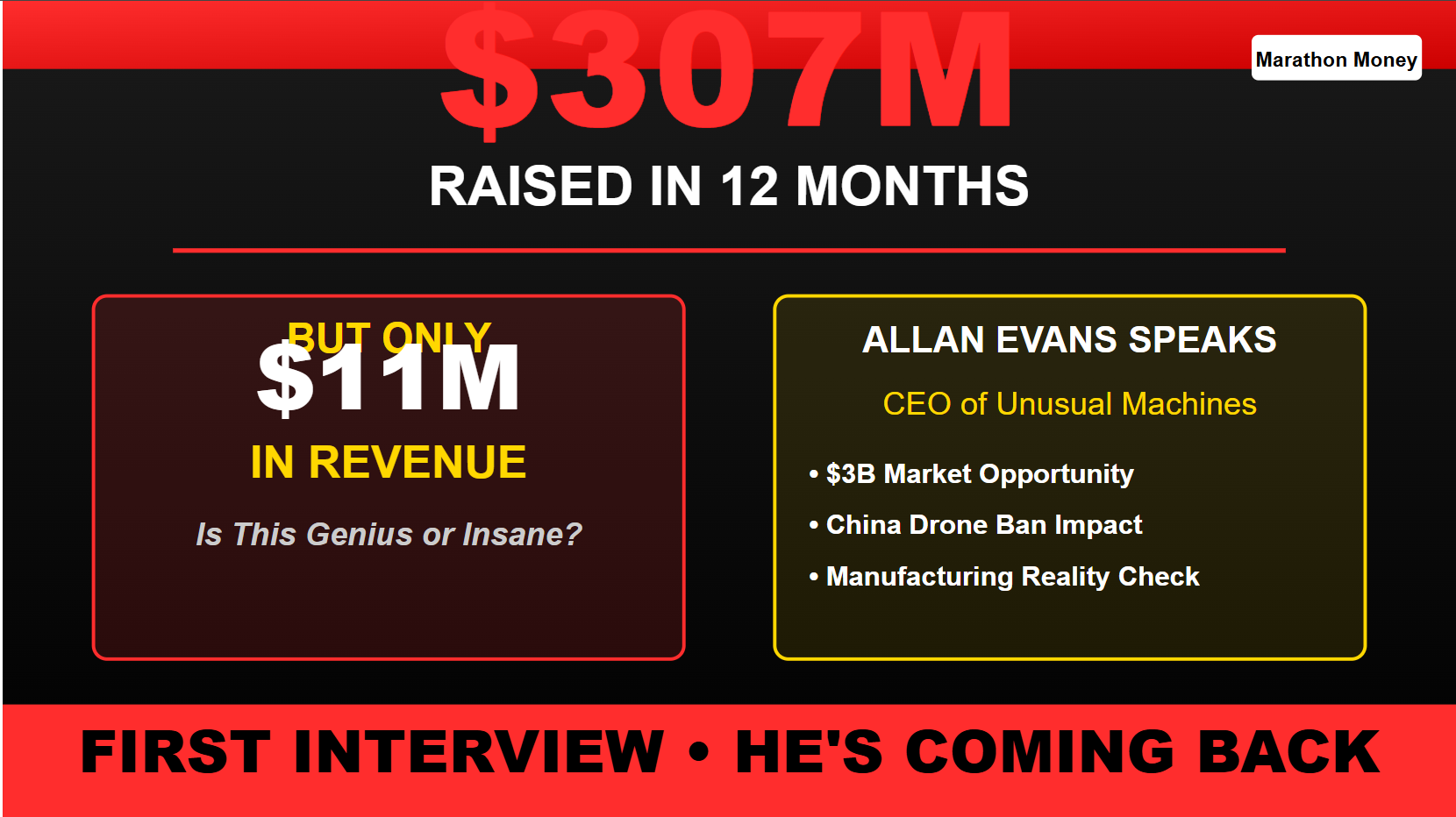
Unusual Machines’ $307 Million Bet: Can a First-Time CEO Build America’s Drone Supplier?
An exclusive Marathon Money interview with UMAC CEO Allan Evans reveals the tensions between ambition, execution risk, and regulatory tailwinds
Allan Evans has a problem that most startup founders would envy: $307.8 million in cash and a market screaming for American-made drone components. But envy and execution are different things.
In an exclusive interview with Marathon Money, the 42-year-old CEO of Unusual Machines laid out an audacious vision: transform a scrappy online retailer into a Tier-1 defense supplier capable of replacing Chinese drone imports across the U.S. military and commercial sectors. He’s betting that a combination of regulatory tailwinds, government contracts, and manufacturing discipline can turn $11.2 million in annual revenue into a multi-billion-dollar business.
The question investors are wrestling with isn’t whether the opportunity exists. It’s whether Allan Evans is the right person to seize it.
Riding the Regulatory Wave
Evans took over as CEO of Unusual Machines in December 2023, just weeks after leaving Red Cat Holdings where he served as Chief Operating Officer. The timing was notable—and the subsequent capital raises have been staggering. In 2025 alone, UMAC raised $157.8 million. Then in March 2026, another $150 million at $17 per share. All while reporting $11.2 million in annual revenue.
On the surface, this looks reckless. The company is burning through capital at a pace that suggests either profound confidence or profound delusion. But there’s a policy tailwind that explains—and perhaps justifies—the aggressive posture.
In December 2025, Congress passed Section 1709 of the FY2026 defense bill, effectively banning the import of DJI and Autel drones if the FCC determines they pose a national security risk. The review is supposed to conclude in 2026. If it does, and the ban sticks, the U.S. government and defense contractors will need an alternative source for drone components.
UMAC is betting it will be them.
“The need for drones is obvious. It is also obvious that we must stop buying Chinese drones and Chinese drone parts.”
Evans is right. The FPV drone market is exploding—military procurement estimates suggest 5 million defense-capable FPV drones will be built in 2025 alone. That’s a market measured in billions.
But here’s the tension: How much of UMAC’s growth is driven by real competitive advantage, and how much is regulatory tailwind that could evaporate if Congress changes its mind, the FCC delays the review, or DJI successfully challenges the ban?
During the interview, when pressed on this dependency, Evans acknowledged the risk but didn’t shy away from it.
“Regulation creates opportunity. Our job is to be the best-positioned company to capture it when it comes.”
That’s honest. It’s also the answer of a CEO riding a wave he didn’t create.
The Capital Deployment Puzzle
Here’s where the real due diligence begins. UMAC raised $307.8 million in 12 months. For a $11.2 million revenue company, that’s extraordinary—27 times annual revenue in a single year.
Most of it went into three buckets: working capital, inventory, and capex for a new drone motor manufacturing facility.
The motor factory is the crown jewel of Evans’ vision. Rather than outsourcing to the 50-plus suppliers UMAC currently relies on (many facing 2–25% tariffs on Chinese components), he’s building an in-house NDAA-compliant motor production line. The theory is elegant: control the supply chain, reduce costs, eliminate tariff exposure, and build a defensible moat.
The reality is harder.
UMAC ended 2025 with $103.3 million in cash. Even accounting for the $150 million raised in March 2026, the burn rate is material. Operating expenses nearly doubled year-over-year, from $18.5 million to $29 million. At current revenue levels, the company is spending 259% of what it brings in on operations.
The math works if—and only if—revenue scales faster than expenses. Evans is projecting significant growth in 2026, driven by new contracts with Performance Drone Works ($3.75 million announced order), Strategic Logix, and ongoing government PBAS (Pathways for Battlefield Air Support) procurement.
We asked for visibility on that backlog. “We have signed contracts that create a pipeline,” he said. But when pressed for Q1, Q2, Q3, Q4 visibility, he demurred. That’s not unusual for private contracts with government agencies—but it’s also where risk lives.
The Margin Mirage
One of the most striking metrics in UMAC’s financials is gross margin expansion. In Q1 2025, the company reported 24% gross margin. By Q4, it had expanded to 36 percent. That’s a 12-point swing in a single year.
Evans attributes it to scale, product mix, and the benefits of bringing manufacturing in-house. And there’s probably truth in that. But when we dug deeper on sustainability, he made a notable admission: Q1 and Q2 2026 margins would dip due to “new hires and new processes.”
Translation: margin expansion is fragile, and it will compress before it expands again.
The question is whether retail investors understand that. When a stock trades at 47x revenue with negative net income, valuation is entirely dependent on margin expansion being real and permanent. If it’s temporary accounting timing—if margins compress when manufacturing scales—the entire thesis collapses.
Evans seemed to understand this. He wasn’t evasive about it. But he also wasn’t defensive. That’s the mark of someone who’s thought through the problem, even if the solution isn’t certain.
The Management Question
Before UMAC, Evans was a serial entrepreneur. He co-founded Avegant, a display technology company focused on augmented reality headsets, where he served as CTO. He later became CEO of Fat Shark, a company that makes FPV goggles. Then he was COO at Red Cat Holdings, a drone manufacturer.
On paper, that’s a resume that screams “right person for this moment.” Drone expertise. Supply chain experience. Capital allocation experience at a publicly traded company.
But there’s a gap in that resume: he’s never actually scaled a manufacturing business. Avegant and Fat Shark were product companies. Red Cat was a holding company. Running a manufacturing facility is a different animal entirely—relentless, margin-dependent, and unforgiving of mistakes.
We asked him directly: “What do you not know about drone motor manufacturing?” He answered honestly. “The details of production scaling at the volume we’re targeting.” He’s surrounding himself with manufacturing experts—his COO Andrew Camden and CFO Brian Hoff have relevant operational experience—but Evans is still a first-time public company CEO managing a $523 million market cap with zero net income.
That’s a lot of trust to place in someone’s learning curve.
The Governance Elephant
One detail from UMAC’s proxy filing stood out: Evans serves as both CEO and Chairman. The company has only three independent directors. And there’s a board interlock with Red Cat Holdings through director Jeffrey Thompson.
This isn’t unusual for emerging growth companies, but it creates obvious governance questions. Who oversees the CEO when he controls the board agenda? How independent is the board when the company is still tethered to its former parent company through board representation?
For institutional investors, this is a yellow flag.
The Competitive Moat Problem
Here’s the uncomfortable truth about UMAC’s competitive position: NDAA compliance is not a moat. It’s an entry fee.
Any well-capitalized competitor can hire engineers, build a facility, and obtain NDAA certification. It takes time and money, but it’s not impossible. The real question is whether UMAC has defensible IP, customer switching costs, or supply chain advantages that competitors can’t replicate.
Evans points to Fat Shark goggles (the company acquired Fat Shark in 2023 and owns the Rotor Riot e-commerce platform). Both are real assets with brand value. But neither is a manufacturing moat. A competitor could build equivalent goggles or launch a competing marketplace.
When we asked Evans point-blank—”What prevents L3Harris or Northrop Grumman from moving into this market?”—he acknowledged the risk. “They could. But they’re focused on larger platforms. We’re building for the agile end of the market.”
That’s a reasonable answer. But it’s not a moat. It’s a niche position that works only if the niche stays unpopular with defense primes.
The Dilution Question
UMAC’s share count tells a story of aggressive capital raising. In 2024, the company had roughly 8 million shares outstanding. By March 2026, that number had ballooned to 40+ million. That’s dilution on a shocking scale.
When we asked about the math—net tangible book value of $1.64 per share in June 2025, raised at $17 per share in March 2026—Evans acknowledged the 10x premium. “We’re confident we’ll grow into that valuation,” he said.
Which is true. But “confident” and “certain” are different words.
For retail investors buying at $17, the question is stark: If revenue scales to $30 million and margins hold at 35%, what’s the actual earnings power? And what’s a fair multiple on those earnings? Because at some point, UMAC stops raising capital and starts proving it can generate returns.
The Path to Profitability
This is the question that separates real businesses from hype. We asked Evans: At what revenue level does UMAC turn EBITDA-positive?
He didn’t have a single number, but he outlined a path. “Somewhere between $25 and $50 million in annual revenue, we should see positive EBITDA.” Net income profitability would come later—he didn’t commit to a timeline.
If that’s true, and if UMAC hits $30 million revenue in 2027 with 35% gross margins and normalized operating expenses, the company could generate $2–3 million in EBITDA. That’s real. It’s also not a home run.
But here’s what matters: for the first time in this conversation, Evans had to articulate real economics. Not TAM size, not regulatory tailwinds, not competitive positioning. Actual dollars in, actual dollars out.
He did it without flinching. That’s where character reveals itself.
The Interview Effect
Sitting across from a CEO for ninety minutes teaches you things you can’t learn from a 10-K. You learn whether they can articulate their own thesis. You learn whether they get defensive when challenged. You learn whether they understand their own risks.
Allan Evans passed those tests. He’s articulate. He understands his business. He doesn’t dodge hard questions. He acknowledges risks without minimizing them.
But understanding your business and successfully executing a manufacturing scale-up are different challenges. Evans has the capital, the market opportunity, and the talent around him. What he doesn’t have is a proven track record in manufacturing at scale.
UMAC is a “show me” story. The narrative is compelling. The tailwinds are real. But the execution risk is enormous. Evans has roughly 18–24 months to prove that UMAC can scale manufacturing, hold margins, and begin the path to profitability.
For retail investors, this is a conviction bet on a first-time CEO with a reasonable thesis and uncertain execution. The stock could easily be a 10-bagger if everything works. It could also collapse if any one of three things goes wrong: regulatory policy shifts, manufacturing execution falters, or customer concentration becomes a real problem.
Allan Evans knows all this. The question is whether the market does.
Important Disclosures & Disclaimers
Affiliate Relationships:
Marathon Money has a paid affiliate relationship with Moomoo. When you sign up for Moomoo through our link (https://start.moomoo.com/MarathonMoney), we earn a commission at no cost to you. This relationship may create a conflict of interest.
Not Financial Advice:
This content is for informational and educational purposes only. It is NOT financial advice. We are not investment advisors. We are not recommending any investment position in Unusual Machines (NASDAQ: UMAC) or any other company.
Financial Metrics:
All financial metrics referenced are based on publicly available SEC filings (10-K, 10-Q, 8-K) as of March 2026. Information is accurate to the best of our knowledge at time of publication.
About Marathon Money:
Marathon Money is an independent financial media show dedicated to helping retail and institutional investors understand small-cap and micro-cap companies with significant growth potential. We conduct deep-dive research and ask hard questions without hype.
Podcast: Play in new window | Download
Discover more from Marathon Money +
Subscribe to get the latest posts sent to your email.