

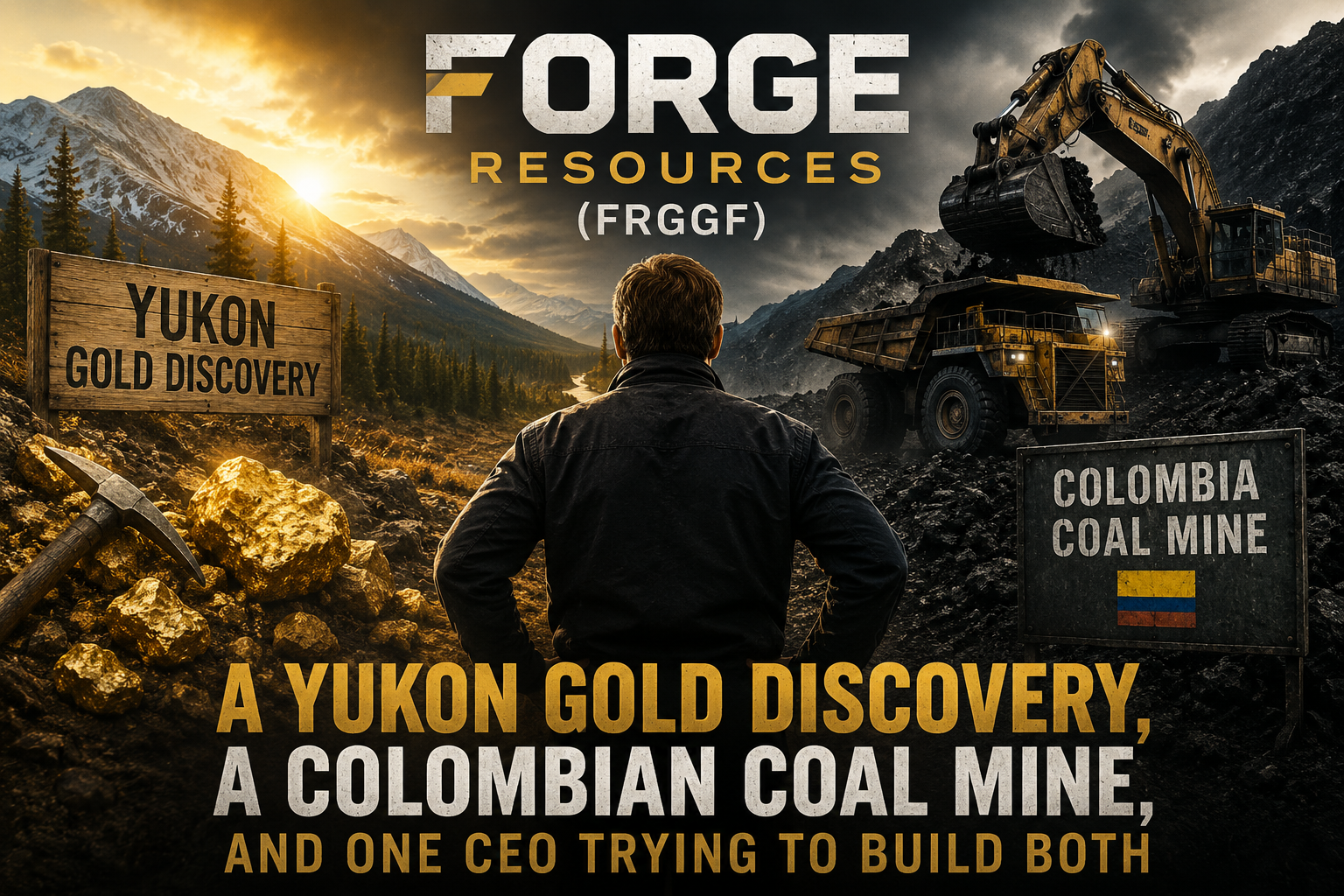
Forge Resources is building two completely different stories under one ticker. Here’s why that matters.
CEO PJ Murphy on a fully permitted coal project months from first revenue, a Yukon gold-copper discovery that just delivered 105 g/t intercepts, and the dilution math investors actually need to model.
Most junior mining companies on the OTC are one-asset stories. They’re either drilling holes hoping for a discovery, or they’ve found something and are trying to permit and build it. Forge Resources Corp (CSE: FRG · OTCQB: FRGGF · FSE: 5YZ) is unusual: they’re running both stories at once. A fully permitted coal project in Colombia heading into bulk sample production, and a 4,723-hectare gold-copper exploration play in the Yukon that just produced one of the most attention-grabbing drill intercepts of the 2025 season.
That dual structure is the entire story — and the entire reason this interview matters for retail investors who are still learning how the sector works. Most YouTube finance content about juniors gets the basics wrong. We sat down with CEO PJ Murphy to walk through both projects, ask the questions investors should be asking, and teach the sector vocabulary along the way.
Below is the breakdown. The full audio interview is embedded above and available everywhere podcasts live. If you want the short version: Forge has real near-term cash flow potential from coal, a legitimate exploration story in Yukon, an active dilution cycle to fund both, and a CEO whose background isn’t traditional mining. Whether that’s a buy depends on what you’re optimizing for.
Key Takeaways
How to think about a junior mining company before you invest
Before we dig into Forge specifically, here’s the framework. Every junior mining company sits somewhere on a lifecycle: exploration (drilling to find mineralization), development (proving and permitting what’s been found), or production (mining and selling commodity for revenue). Each phase has different risks, different capital needs, and different valuation methods.
Most OTC-listed juniors are pure exploration. They burn cash drilling, raise more cash, and either prove out a deposit (rare) or fail (common). The valuation is essentially “how big could this become” times “how likely is that to happen.” Production-stage companies are valued on earnings and reserves. Development-stage companies fall in between — discounted cash flow on a project that doesn’t yet exist.
The terms you need to know to follow this interview
NI 43-101: Canadian Securities standard for resource disclosure. A formal report from a qualified geologist quantifying tonnes and grade. Without one, a project is just drill holes. With one, it’s an asset with a number.
g/t: Grams per tonne — how the industry measures gold grade. 1 g/t Au is often economic in open-pit settings. 3+ g/t is strong. 100+ g/t is bonanza grade and typically narrow.
Drilled core length vs true width: The headline number (“44.75 metres at 3.4 g/t”) is the length of the hole through mineralization, not the actual thickness of the deposit. True width can be substantially less.
Flow-through financing: A Canadian-specific tool that lets juniors fund exploration cheaply by passing tax deductions to investors. Cheap capital, but still dilution.
Bulk sample: Trial extraction — typically 5,000 to 50,000 tonnes — that proves a project can produce sellable material. The first cash event for a development-stage company.
Forge is unusual because it occupies two phases at once. La Estrella is in late development, weeks to months from a bulk sample. Alotta is in mid-exploration, drilling toward a maiden resource estimate. The implication for investors: you’re underwriting two completely different risk-reward profiles in a single share.
La Estrella: The coal story most American investors haven’t seen
La Estrella sits in Santander, Colombia, held through Forge’s 80% interest in Aion Mining Corp. The project is fully permitted, with eight known coal seams of both metallurgical and thermal grade. The distinction matters more than most retail investors realize.
Metallurgical (or “coking”) coal is used to make coke for blast-furnace steelmaking. There is no large-scale substitute — green steel technologies are improving but nowhere near commercial replacement. Met coal has historically traded between $150 and $300 per tonne depending on grade and market conditions, and demand tracks global steel and infrastructure spend. Thermal coal is burned for electricity. It faces ESG headwinds in Europe and parts of North America, but Asian and Latin American demand remains strong.
Forge has reported lab results indicating the La Estrella coal is high BTU (high energy density), low sulphur (cleaner burn), and low ash (less waste residue). Those three specs together qualify it for the premium end of both the met and thermal markets, which gives Forge optionality on offtake — they can pivot toward whichever buyer pays best.
The first cash moment for a development-stage mining company
A bulk sample is the trial extraction that proves a project works. Forge has been advancing toward a 20,000-tonne program at La Estrella. That’s not full commercial production — Colombia has permitted them for up to 180,000 tonnes per year — but the bulk sample produces real, sellable coal and generates the company’s first revenue.
Public reporting suggests realized pricing in the $200–250 per tonne range. Multiply that by 20,000 tonnes and back out cash costs, and you have the first concrete data point on whether the underlying mine economics work. That’s the moment that converts La Estrella from a story into an operating business.
The mechanics of getting there are straightforward but capital-intensive. Forge has been advancing an underground ramp — a sloped tunnel that gets equipment, ventilation, and conveyor systems down to the coal seams. Recent updates report the ramp face has re-encountered a coal seam, with the operational team fully deployed and resin injections completed for ground stabilization. Coal prices have been rising as Forge advances development, which improves the project’s economics if first shipments arrive into a strong market.
“Near-term production” has been part of Forge’s language for over a year. The actual gating events to first revenue are physical — meters of ramp left, equipment delivery, transport logistics, offtake arrangement. Investors should expect timeline slippage as part of the base case, not the bear case. Colombian coal also carries jurisdictional considerations: the political environment around coal exports has been mixed under recent governments, and labor disputes have hit other Colombian operators.
Alotta: A 4,723-hectare bet 50 km from one of the world’s biggest undeveloped porphyries
The Alotta project is structured differently. Forge holds an option to earn 60% in the joint venture covering 230 mineral claims totaling 4,723 hectares in the Yukon’s Dawson Range — the same belt that hosts the Casino deposit, one of the world’s top 10 undeveloped copper-gold porphyries. The Casino comparison shows up in every Forge release for a reason.
How most of the world’s copper actually gets mined
A porphyry deposit is a massive volcanic-origin body of disseminated copper, gold, or molybdenum mineralization. They’re typically lower grade than vein deposits but vastly larger. Bingham Canyon, Chuquicamata, Grasberg — the world’s biggest copper mines are porphyries.
The Casino deposit, 50 km from Alotta, has measured and indicated resources in the billions of pounds of copper and millions of ounces of gold. “Same belt” doesn’t mean “same deposit” — but it does mean the geological recipe is permissive. The ingredients are present. Whether Alotta becomes a world-class porphyry depends on what the drill bit finds across more meters and more zones.
The 2025 Alotta drill program completed 2,685.66 meters across 9 holes, bringing the total since 2023 to 15 holes. The headline result was hole ALT-25-012 in the Payoff Zone: 76.93 meters at 2.03 g/t gold from 223 meters depth, including 44.75m at 3.40 g/t and a 1.25m intercept at 105 g/t Au. That last number is what got the retail investor world paying attention.
But the more strategically important result was hole ALT-25-013. Drilled 800 meters west of the Payoff Zone, it returned 112.21 meters at 0.66 g/t gold from 35 meters depth, including 55.52m at 1.04 g/t and visible gold at 25.8 g/t over 1.6m. That hole defines a brand new zone — the Alimony Zone — and it changes the geology story. Two distinct mineralized zones 800 meters apart suggest a much larger, district-scale system rather than a single localized vein.
Severance, a third zone, also returned widespread gold with elevated copper. The combined picture: a 500-meter gold-enriched trend along strike at Payoff, open in both directions, plus a separate discovery at Alimony, plus copper signals at Severance. That’s no longer a one-target drill program — it’s the early outline of a system.
Every Forge release includes the standard caveat: “Additional drilling is required to establish true width.” The 44.75-meter intercept is the length of core through mineralization, not the actual thickness of the deposit. Depending on hole orientation, true width might be 50–80% of the reported core length. Until Forge publishes a maiden NI 43-101 resource estimate, every drill number is suggestive rather than definitive.
Same belt isn’t the same deposit. But same belt means the recipe’s there. The drill bit decides the rest.
On Alotta vs Casino — Marathon Money interview
Capital structure, dilution, and what investors should model
Forge has approximately 87.5 million shares outstanding, with active warrants and options outstanding. The company has run multiple financings through 2025 and into 2026: a flow-through round at $0.66 per unit closed in June 2025, a CAD $10 million private placement announced in February 2026 with first closing in March, and a second flow-through closing of up to CAD $4 million at $0.50 per unit (with warrants at $0.70 expiring in 36 months) expected around April 30, 2026.
Translation for retail investors: the share count is growing. That’s the cost of running two capital-intensive projects simultaneously without revenue. It’s neither unusual nor disqualifying for a junior — most exploration companies finance this way — but it does mean the math investors need to model is per-share, not absolute.
If La Estrella generates first revenue this year and Alotta’s 2026 drilling expands the system, the per-share value can grow even with dilution because the project value grows faster. If either project slips badly, the dilution compounds against you. That’s the trade-off you’re underwriting when you buy FRGGF.
Why the CEO’s background matters (and why it might not)
PJ Murphy is not a career miner. He holds a BSc from McGill and a Doctor of Dental Surgery from Dalhousie, with 25+ years of management experience across healthcare and real estate. He took over after Forge’s rebrand from Benjamin Hill Mining Corp. in April 2024.
The technical anchor on the team is Lorne Warner — President and a P.Geo, qualified to sign off on NI 43-101 reports. COO Cole McClay handles operational management. VP Finance Camilo Cordovez Amador joined in November 2024 with 16 years of investment banking experience advising on $100M+ projects. Special Advisor Patrick Bonner holds a disclosed 8% stake in the company, which provides notable insider alignment.
Whether Murphy is the right CEO is a question reasonable investors will answer differently. The bull case is that capital markets and deal-making skills matter more for a development-stage junior than 30 years of mining ops experience — and that the technical team is already built around him. The bear case is that mining is a discipline, technical decisions move millions of dollars, and you want a CEO who’s lived through cycles. We pressed Murphy on this directly in the interview.
What we’d watch over the next 12–24 months
Three concrete milestones we’ll be holding Forge accountable to over the next two years:
- First coal shipment from La Estrella. Date, tonnage, realized price per tonne, all-in sustaining cost. This converts the company from “story” to “operating business.”
- Maiden NI 43-101 resource at Alotta. Without a published resource, drill results stay speculative. The path requires more meters, tighter spacing, and a QP sign-off. Watch for a target date.
- Treasury and dilution discipline. Where does the share count land at the end of 2026 and 2027? At what share price does management commit to NOT raising? Open-market insider purchases would be a strong signal.
None of those milestones are guaranteed. Junior mining companies miss timelines as a rule, not as an exception. The reason we’re publishing this interview, and why we’ll come back to Forge in 2027, is to create the accountability record. The follow-up matters as much as the original conversation.
Trade with the tools the pros use — moomoo
moomoo is the trading platform built for people who are serious about investing. Pro-level tools in a clean, easy-to-use app: real-time Level 2 data, Morningstar research, AI-powered market insights, and advanced order types — all in one place, completely free to use.
Right now, new users can earn up to $1,000 in NVDA stock just for funding an account, plus 8.1% APY on idle cash for 60 days.
Open Your Account →Quick answers to questions investors actually ask
Forge Resources relationship. Marathon Money may have a paid promotional relationship with Forge Resources Corp in connection with this interview. All editorial decisions, questions, and analysis are produced independently. The presence of a paid relationship does not change what we publish — but you deserve to know about it.
moomoo sponsorship. The moomoo block above is a paid sponsorship for this episode. Marathon Money earns a commission on qualifying account openings via the affiliate link. See the disclosure within that block for full terms.
Not investment advice. Nothing in this article or the accompanying audio interview is investment, financial, legal, or tax advice. Marathon Money is a financial media show, not a registered investment advisor. Junior mining companies, including Forge Resources, are speculative investments that can lose 100% of their value. Past performance does not predict future results. All figures cited are based on company disclosures, public filings, and third-party reports as of the publication date and may have changed.
Sources. Company news releases (Forge Resources Corp, January–April 2026), public NI 43-101-related disclosures, Yahoo Finance, TipRanks, Junior Mining Network, INN, and the Marathon Money interview with PJ Murphy. Specific drill results referenced (ALT-25-012 and ALT-25-013) are drawn from Forge’s reported 2025 program highlights.
Do your own research. Read the company’s filings on SEDAR+ and the OTC Markets disclosure system. Listen to the full interview. Talk to a registered financial advisor before making any investment decision.
Podcast: Play in new window | Download
Discover more from Marathon Money +
Subscribe to get the latest posts sent to your email.