

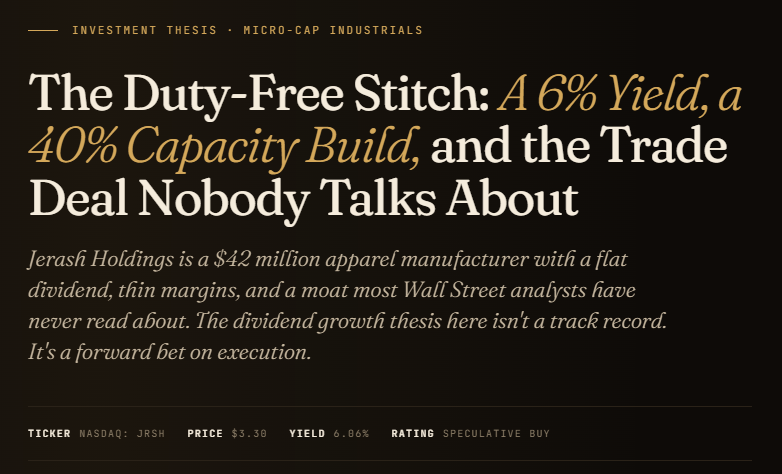
The Duty-Free Stitch: A 6% Yield, a 40% Capacity Build, and the Trade Deal Nobody Talks About
Jerash Holdings is a $42 million apparel manufacturer with a flat dividend, thin margins, and a moat most Wall Street analysts have never read about. The dividend growth thesis here isn’t a track record. It’s a forward bet on execution.
01The Thesis, in One Page
Executive Summary
Jerash Holdings makes clothes. Specifically, it cuts and sews ready-made sportswear and outerwear in six factories in Jordan for some of the largest apparel brands on earth: VF Corporation (The North Face, Timberland, Vans), New Balance, G-III (Calvin Klein, Tommy Hilfiger, DKNY, Guess), American Eagle, and Skechers. It employs roughly 5,000 people and ships over 14 million pieces of clothing a year. None of that is interesting.
What is interesting is where the factories sit. Jordan is one of the only countries on earth with a Free Trade Agreement and a Qualifying Industrial Zone arrangement that lets it ship finished apparel into the United States duty-free and quota-free. In a world where tariffs on Chinese goods keep climbing, where Vietnam keeps getting reclassified, and where the entire global apparel supply chain is hunting for a new home, Jerash is sitting on a piece of trade real estate that nobody is building more of. That is the moat.
The pitch in one sentence: buy a 6% yield today, get paid to wait while management executes a 40% capacity expansion and a strategic partnership with Hansoll Textile that is already raising Q4 guidance to 23-26% revenue growth. If execution holds, this becomes a real dividend growth name by fiscal 2028. If it doesn’t, you collected the yield.
This is not a Dividend Aristocrat. The dividend has been flat at $0.05 per quarter for seven straight years. The current payout ratio is over 140% of trailing earnings. The free cash flow over the last nine months was negative. We are going to be honest about all of that. The thesis is forward-looking, the execution risk is real, and the position size should reflect that. But the asymmetry — at $3.30 with a 6% yield and a clear catalyst stack — is interesting enough to put on the analyst desk and walk you through every line of it.
02The Business
What Jerash Actually Does
Imagine you run product at Nike or New Balance. You design a jacket. You don’t want to build a factory, hire 800 sewing operators, source the fabric, and run quality control. You call a company like Jerash. You hand them the spec, the volume order, and the deadline. They handle the rest — sourcing, cutting, sewing, finishing, packing, and shipping it on a container to your distribution warehouse in New Jersey or California.
That is the entire business. They are a contract manufacturer for branded apparel. They make jackets, polo shirts, t-shirts, pants, shorts, and some niche personal protective equipment (medical scrubs, masks, surgical gowns). Their factories sit in the Al-Tajamouat Industrial City in Amman, Jordan. They run six production units, employ around 5,000 people, and have annual capacity above 14 million pieces.
The customer concentration is meaningful but not dangerous. Their named brand customers include VF Corporation (which owns The North Face, Timberland, and Vans), New Balance, G-III Apparel Group (which licenses Calvin Klein, Tommy Hilfiger, DKNY, and Guess), American Eagle, and Skechers. They added a strategic partner last year, Hansoll Textile, a major South Korea-based global apparel group, which has been routing large orders through Jerash on behalf of one of Hansoll’s largest customers — a U.S.-based multinational omnichannel retailer that management hasn’t named publicly but is large enough to materially move quarterly numbers.
The corporate parent, Jerash Holdings (US) Inc., is incorporated in Delaware and headquartered in Fairfield, New Jersey. Chairman and CEO Sam Choi (Choi Lin Hung) has been at the helm since the 2018 NASDAQ listing. CFO Gilbert Lee handles the financials and the analyst calls.
03The Moat
Jordan and the Duty-Free Stitch
This is the part of the thesis that doesn’t get covered enough. Jerash’s structural competitive advantage is not technology, not scale, not brand. It is geography combined with two trade agreements.
The U.S.-Jordan Free Trade Agreement, signed in 2001, eliminates tariffs on essentially all goods traded between the two countries. The Qualifying Industrial Zone (QIZ) program, layered on top, provides additional duty-free and quota-free access for products manufactured in designated Jordanian industrial zones, provided certain Israeli content requirements are met. Al-Tajamouat is a QIZ.
What this means in practice: when an American brand asks Jerash to manufacture 100,000 jackets and ship them to a U.S. port, the customer pays zero tariff at U.S. customs. Compare that to a Vietnamese factory facing potential 20-46% reciprocal tariffs, a Chinese factory facing layered tariffs that can exceed 50% on apparel categories, or a Bangladeshi factory facing logistics complexity and longer lead times. The Jordan duty-free advantage translates directly into a price-competitive bid — Jerash can charge slightly more than a Vietnamese factory and still deliver a lower landed cost to the customer.
Management has explicitly called out the tariff backdrop as a tailwind. On the Q2 FY2026 earnings call, the CFO noted that “the recent shift in U.S. tariff policy has accelerated the urgency with which businesses are looking to diversify their manufacturing footprint.” Translation: every time the U.S. raises tariffs on Asian apparel, Jerash’s phone rings. Their facilities are already booked through July 2026 with commitments coming in for the rest of the calendar year. That is not a company hunting for business. That is a company turning business away.
The risk to the moat: trade agreements can change. The QIZ structure has political dependencies, and a major shift in U.S.-Israel-Jordan relations could theoretically affect the arrangement. But the U.S.-Jordan FTA is structurally stable, has bipartisan support, and has survived multiple administrations. The moat is real and durable, not bulletproof.
04The Dividend Truth
What You’re Actually Buying
Let me be straight before we get to the growth thesis. Jerash is currently not a dividend growth stock by any conventional measure. Here is what the data says:
| Metric | Value |
|---|---|
| Forward Annual Dividend | $0.20 |
| Quarterly Payment | $0.05 |
| Current Yield | 6.06% |
| Years Paying Dividend | 7 |
| 1-Year DPS Growth | 0% |
| 3-Year DPS Growth | 0% |
| 5-Year DPS Growth | 0% |
| Trailing EPS | $0.14 |
| Payout Ratio (TTM) | ~143% |
| 9-Month FCF (FY2026 YTD) | -$3.5M |
Read those numbers carefully. The dividend has been the exact same nickel per quarter for seven straight years. Earnings are not currently covering the dividend — JRSH is paying out roughly $2.5 million annually on $1.8 million of trailing net income. Operating cash flow for the first nine months of fiscal 2026 was negative $3.5 million, driven by a build in accounts receivable as new high-volume orders ramped up. The dividend is being maintained partly out of the balance sheet, not generated by operations.
This is a yield play with execution risk on the underlying business. If you are buying JRSH today, you are not buying a dividend track record. You are buying a high current yield with the expectation that the underlying business is at an inflection point, and that the dividend will be properly covered within two to three years. That is a fundamentally different thesis than buying a Dividend Aristocrat. Position size accordingly.
05The Dividend Growth Path
How the Forward Thesis Works
So why is this in a “dividend growth” thesis at all? Because the catalyst stack management is executing on, if it works, takes the company from a 143% payout ratio to a sub-80% payout ratio inside 24 months — and that is the moment a 7-year-flat dividend becomes a candidate for its first hike.
Here is the math. Trailing twelve-month revenue is roughly $152.6 million on a 1.18% net margin, generating $1.8 million in net income or $0.14 in EPS. The total annual dividend obligation at $0.20 per share on roughly 12.7 million shares outstanding is about $2.5 million.
| Scenario | Revenue | Net Margin | EPS | Payout Ratio |
|---|---|---|---|---|
| Trailing (Today) | $152.6M | 1.18% | $0.14 | 143% |
| FY2027 Base | $185M | 2.5% | $0.36 | 56% |
| FY2028 Bull | $220M | 3.5% | $0.61 | 33% |
| FY2027 Bear | $160M | 1.5% | $0.19 | 105% |
The base case is not aggressive. It assumes the 184,000 square foot facility comes online by year-end 2026 and adds the expected 40% capacity. It assumes Hansoll continues placing follow-on orders. It assumes Q4 FY2026 hits the company’s own guidance of 23-26% revenue growth (already telegraphed by management on the most recent earnings call). And it assumes net margins recover toward the 2.5-3.5% range Jerash hit before the pandemic and the Red Sea shipping disruptions of FY2024.
If the base case plays out, the payout ratio drops below 60% by fiscal 2027. That is the moment a board that has held the line at $0.05 for seven years has both the cash flow and the strategic reason to raise. A move from $0.05 to $0.06 per quarter — a 20% dividend hike — would put the forward yield at $0.24 per share, or roughly 7.3% on the current price. That is the dividend growth thesis.
This is not guaranteed. The bear case is real and we will get to it. But the math of the base case is not exotic. It does not require Jerash to become a different company. It requires them to execute on commitments they have already publicly made.
06The Catalyst Stack
What Drives the Forward Numbers
The 184,000 Square Foot Facility
In late January 2026, Jerash announced the acquisition of a 184,000 square foot manufacturing building and associated land in Amman from Housing Bank for Trade and Finance. The total renovation and equipment investment is approximately $5 million, funded through long-term debt. The facility is expected to come online by year-end 2026 or early 2027 and is targeted to expand total manufacturing capacity by at least 40%. This is the single biggest physical investment in the company’s history. Management called it a “five-year growth strategy milestone.” Translation: this is the asset that lets them say yes to the orders they’ve been turning away.
The Hansoll Textile Partnership
The collaboration with Hansoll Textile — a major South Korean apparel group — began producing orders in mid-2025. The initial order was 3 million pieces of girls’ shorts for a U.S.-based multinational omnichannel retailer (Hansoll’s largest customer, unnamed publicly but large enough that the CFO described the order as transformative for quarterly economics). The first phase shipped in fall 2025. The second phase was set to complete by end of February 2026. A second purchase order on a different style is already in active production discussion. This partnership is the largest near-term volume driver and is already showing up in margin expansion: gross margin in Q3 FY2026 hit 16.9%, up 170 basis points year-over-year, partly because long high-volume Hansoll runs reduce style changeovers and improve manufacturing efficiency.
The Rural Facility Build-Out
In parallel, Jerash is collaborating with the Jordanian Ministry of Labor on two additional smaller facilities in rural Jordanian towns. These are targeted for fiscal 2027 completion and expected to add an additional 5-10% to total production capacity. The government partnership angle is strategic — local employment commitments in rural areas earn political goodwill and may unlock additional tax or operational incentives.
The Tariff Tailwind
Every new tariff escalation on Vietnamese, Chinese, or Bangladeshi apparel imports raises the relative attractiveness of Jordan-sourced product. Management has stated explicitly that tariff uncertainty is driving inbound inquiries. This is a tailwind they did not have to build — it landed in their lap and is showing no signs of reversing.
Q4 FY2026 Guidance
Management has guided fiscal Q4 2026 revenue growth of 23-26% year-over-year on prior-year Q4 revenue of $29.3 million, implying $36-37 million in Q4. Gross margin is guided to 14-16%. That gets the full fiscal year to roughly $160-162 million, an 11% increase over the record $145.8 million in FY2025. The big inflection comes in FY2027 when the new facility is fully online.
07The Q3 FY2026 Report Card
What the Last Earnings Print Actually Showed
Jerash reported fiscal Q3 2026 on February 9, 2026, and the print was the cleanest in years. Here is the side-by-side:
| Metric | Q3 FY26 | Q3 FY25 | Δ YoY |
|---|---|---|---|
| Revenue | $41.8M | $35.4M | +18.0% |
| Gross Margin | 16.9% | 15.2% | +170 bps |
| Operating Income | $1.9M | $0.66M | +~190% |
| Net Income | $1.2M | $0.45M | +~167% |
| Diluted EPS | $0.09 | $0.04 | +125% |
| Cash & Equiv. | $13.2M | — | — |
Revenue beat the consensus estimate of $39.3 million by approximately 6%. EPS of $0.09 beat the $0.07 consensus by 28.6%. The stock rose 8.5% in pre-market trading following the report. Gross margin expansion of 170 basis points is the most important line in the report — that is direct evidence that the Hansoll efficiency thesis is real, not theoretical.
The one yellow flag in the Q3 print is operating cash flow. Net cash used in operations for the first nine months of fiscal 2026 was approximately $3.5 million, compared to $581,000 in the same period of fiscal 2025. Management attributed the swing primarily to higher accounts receivable as new high-volume Hansoll orders ramped, plus inventory build in anticipation of Q4 shipments. This is the kind of working capital cycle that is normal during a ramp phase, but it is something to monitor in subsequent quarters. We want to see receivables convert to cash before the new facility comes fully online.
08Valuation and Price Scenarios
What the Stock is Worth Under Different Outcomes
At $3.30, Jerash trades at approximately 24x trailing earnings, 0.27x trailing sales, and 0.66x book value. The trailing P/E is artificially elevated because trailing net income is depressed by the FY2024 disruptions. The forward P/E, if the base case plays out, is dramatically lower.
| Company | Mkt Cap | P/S | P/B | Yield |
|---|---|---|---|---|
| Jerash Holdings (JRSH) | $42M | 0.27x | 0.66x | 6.06% |
| Kontoor Brands (KTB) | $3.4B | 1.3x | 5.8x | 3.8% |
| VF Corporation (VFC) | $6.8B | 0.6x | 3.2x | 2.6% |
| Levi Strauss (LEVI) | $8.9B | 1.5x | 4.4x | 2.4% |
| Culp Inc. (CULP) | $65M | 0.3x | 0.9x | — |
JRSH trades at the deepest discount in the peer set across price-to-sales and price-to-book. The valuation discount reflects three things: micro-cap illiquidity, no analyst coverage outside of DA Davidson and a handful of regional firms, and the weak trailing margin profile. None of those reasons are tied to the moat or the catalysts. They are tied to market structure.
DA Davidson maintains a Buy rating with a $4.00 12-month price target, which sits between our bear and base cases. Their target implies a P/E of roughly 13-14x on FY2027 EPS estimates, which is conservative but reasonable for a recovering micro-cap.
09The Scorecard
The Good and the Bad, Side by Side
- Structural Trade MoatDuty-free, quota-free U.S. access via FTA and QIZ is rare and hard to replicate.
- 6% Yield TodayIncome while waiting for the operational thesis to play out. You get paid to be patient.
- Tariff TailwindEvery new U.S. tariff on Asian apparel makes Jordan more attractive. Free option on policy.
- Capacity Catalyst184,000 sq ft facility + 5-10% rural expansion. Already booked through July with commitments rolling in.
- Hansoll PartnershipInitial 3M-piece order shipped, margin expansion proven, second order in active discussion.
- Below Book ValueStock trades at 0.66x book. Margin of safety on assets even if growth stalls.
- Customer QualityVF, New Balance, G-III, American Eagle, Skechers. Real names with real volume needs.
- Q3 Beat & RaiseLatest print beat revenue and EPS, guided Q4 to +23-26% growth.
- Dividend Not EarnedPayout ratio over 140% of trailing EPS. Funded from balance sheet, not operations, today.
- Zero Dividend GrowthSeven years, same $0.05 per quarter. Growth thesis is forward-looking, not historical.
- Negative Operating Cash Flow$3.5M used in 9 months of FY2026. Working capital strain during ramp.
- Customer ConcentrationLosing one major brand could swing a quarter materially. Always a small-cap risk.
- Geopolitical AdjacencyJordan is stable, but the neighborhood is not. Red Sea / Haifa Port disruptions hit FY2024 hard.
- Razor-Thin Margins1.18% trailing net margin. Cotton, freight, labor shocks can wipe out a quarter fast.
- Micro-Cap Illiquidity$42M market cap means wide spreads, low volume, and limited institutional interest.
- Execution Risk on Facility40% capacity expansion requires hiring 2,000-3,000 new workers without breaking margins.
10Why I’d Buy It
The Personal Case
Here is how I think about Jerash inside a personal dividend portfolio.
At $3.30, you are paying about half of trailing twelve-month sales for a business that has structural duty-free access to the world’s largest consumer market and a clear path to 40% capacity growth. The dividend is high enough at 6% that even if the stock does nothing for two years, you collect a yield that beats every major index, every blue-chip dividend stock, and most BDCs in your watchlist. The moat is real. The catalysts are not theoretical — they are physically being built right now.
The reason this fits my personal style is that I am hunting for asymmetric setups in the dividend space. I want stocks where the downside is bounded by yield and book value, and the upside is unbounded by execution. JRSH fits that profile. The downside scenario is roughly $2.20 — about 33% — while the bull scenario is roughly $6.50 — about 97% upside in 24 months — plus the dividend the entire time. That is a heads-I-win-bigger-than-tails-I-lose setup.
I would not put this at 10% of a portfolio. This is a 1-3% position for me. It is a satellite holding, not a core. The micro-cap illiquidity alone makes it inappropriate as a primary position. But for the satellite portion of a dividend-focused portfolio, sitting next to a SCHD, a VYM, or a basket of BDCs, this is exactly the kind of name where one or two big winners pay for the basket of micro-caps that don’t work.
If the base case plays out, this is a $4.50 stock paying a hiked dividend in 18 months. If the bull case plays out, it is a $6+ stock with a 7%+ yield on cost. If the bear case plays out, I collected the yield while it underperformed, and the structural moat keeps a floor under the price. That is a setup I want in my book.
11Why You Shouldn’t Buy It
The Bear Case in Plain English
This is the part of the article where most analysts get scared and soften their language. We won’t. Here are the genuine reasons not to own JRSH, and they are not small.
You Need Income You Can Trust
If you are buying dividend stocks because you need predictable, growing income that you can rely on — retirement, supplemental income, a fixed budget — JRSH is the wrong instrument. The payout ratio is over 140%. The dividend has not grown in seven years. The board could cut the dividend tomorrow if operating cash flow does not improve, and the stock would likely fall 20-30% the same day. SCHD, VYM, or a basket of Dividend Aristocrats deliver income you can plan around. JRSH does not. Anyone confusing high yield with reliable income is making a category mistake.
You Can’t Tolerate Micro-Cap Volatility
$42 million market cap means the stock can move 5-10% on a single small institutional order. Bid-ask spreads are wider than what large-cap investors are used to. If you sell into a thin market on a bad day, you will get filled at prices that feel insulting. If you cannot stomach watching a position drop 15% in a week with no news, this is not a position for you.
You Don’t Believe in the Execution
The entire forward thesis rests on management actually building, staffing, and ramping the new facility on schedule and on budget. That is a $5 million renovation, plus the recruitment of 2,000-3,000 new workers, plus integration of new production lines, plus continued performance on the existing book of business. Apparel manufacturers miss timelines all the time. If you do not trust Sam Choi and the operational team to execute, the thesis evaporates and you own a high-yield trap with a flat dividend.
Geopolitics Goes Sideways
Jordan is stable today. The neighborhood is not. A regional flare-up affecting shipping lanes through the Red Sea or the Gulf of Aqaba can disrupt material delivery and finished goods shipments. FY2024 demonstrated this — the company’s results were materially affected by Red Sea shipping disruptions. The QIZ structure also has political dependencies that could theoretically be revisited. None of these risks are high probability, but they are real, and you have to be willing to underwrite them.
You Want Liquidity in a Crisis
In a market panic, micro-caps trade like they have no buyers, because they often don’t. If you need to liquidate this position in a hurry, you will accept a meaningful discount to fair value. Anyone who needs the ability to exit cleanly should size accordingly or pass entirely.
Marathon Money has not been paid, sponsored, or compensated in any form by Jerash Holdings (US) Inc., its officers, employees, affiliates, investors, or any related third party to produce, publish, distribute, or promote this analysis. We are not promoting this stock on behalf of anyone. This is independent commentary from the Marathon Money analyst desk based on public filings, earnings calls, and our own research. Nothing here is a recommendation to buy or sell. Do your own due diligence.
Marathon Money uses Moomoo. Commission-free trading on stocks and ETFs, advanced charting, Level 2 market depth, pre-market and after-hours trading, and free shares of stock when you sign up and fund your account. It’s the brokerage we use to manage the dividend portfolio we talk about on the show.
Open a Moomoo Account →Additional Disclosures
Not financial advice. This article reflects the opinion of the Marathon Money analyst desk and is for informational and educational purposes only. Nothing in this article should be construed as a recommendation, solicitation, or offer to buy, sell, or hold any security. Always conduct your own due diligence and consult a licensed financial advisor before making any investment decision.
No paid relationship with Jerash Holdings. To be unambiguous: Marathon Money has not been paid, sponsored, or compensated in any form by Jerash Holdings (US) Inc., its officers, affiliates, or any related third party to produce or distribute this analysis. This is independent commentary.
Moomoo affiliate disclosure. Marathon Money has a paid affiliate relationship with Moomoo. We may receive compensation when readers open and fund an account through our affiliate link. This affiliate relationship is entirely separate from and unrelated to any specific stock, company, or analysis we publish. It does not influence our research or our coverage decisions.
Position disclosure. The author and Marathon Money may or may not hold positions in JRSH. Any position taken is sized consistent with the speculative-buy framework described above.
Data sources. Financial data sourced from company filings, investor relations releases, the Q3 FY2026 earnings call transcript, DA Davidson research, Yahoo Finance, Nasdaq, and Stock Analysis. Prices and valuation multiples may have changed since publication.
Investment risk. Micro-cap stocks carry substantially elevated risk including illiquidity, customer concentration, volatility, and execution risk. Dividend payments are not guaranteed and can be reduced or eliminated at any time at the discretion of the issuer’s board of directors. Past performance is not indicative of future results.
Discover more from Marathon Money +
Subscribe to get the latest posts sent to your email.